
Why Every Software Company Needs A CRM Agent
And how founders can build one

Over the past quarter, nearly every founder I meet has been exploring ways to bring AI into their workflows — not as a flashy feature, but as real leverage. The CRM is usually the first place they look, and for good reason: it’s where data, follow-ups, and accountability lives.
Every software company runs on customer data, but most still manage it through a patchwork of manual workflows — logging calls, updating notes, chasing follow-ups, and pulling reports. These are necessary but repetitive tasks that drains time, teams, and lacks consistency.
A CRM agent automates those tasks. It’s not a chatbot; it’s a background system that connects to your CRM, reasons through what needs to happen, and takes action. The result is less admin, faster cycles, and cleaner data. In this post, I’ll break down what a CRM agent actually does and share a simple roadmap any founder can use to build one — no AI research team required.
A Simple Example
Imagine a rep says:
“Follow up with all leads from last week and personalize the message.”
Here’s what happens behind the scenes:
The agent queries the CRM for leads from the past week.
It prompts an LLM to draft personalized emails based on each profile.
It sends those messages through the CRM’s native system.
It logs each interaction automatically.
The LLM handles reasoning and content.
The workflow layer ensures ordering and reliability.
APIs provide access to the CRM and communication tools.
Cloudflare outlined this exact stack in its AI presentation earlier this year (see below). It’s the clearest blueprint yet for how agentic systems will interact with enterprise software.
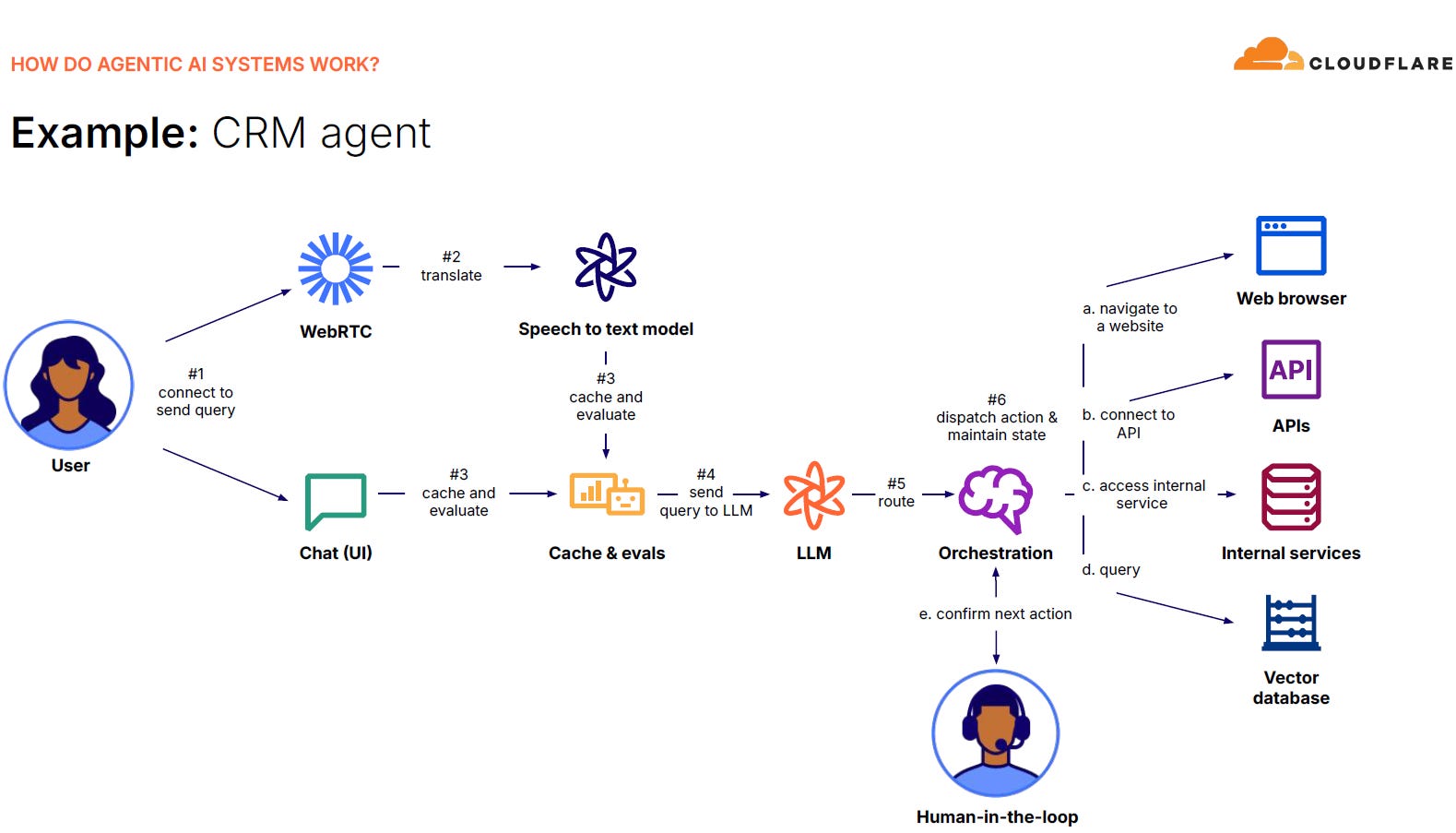
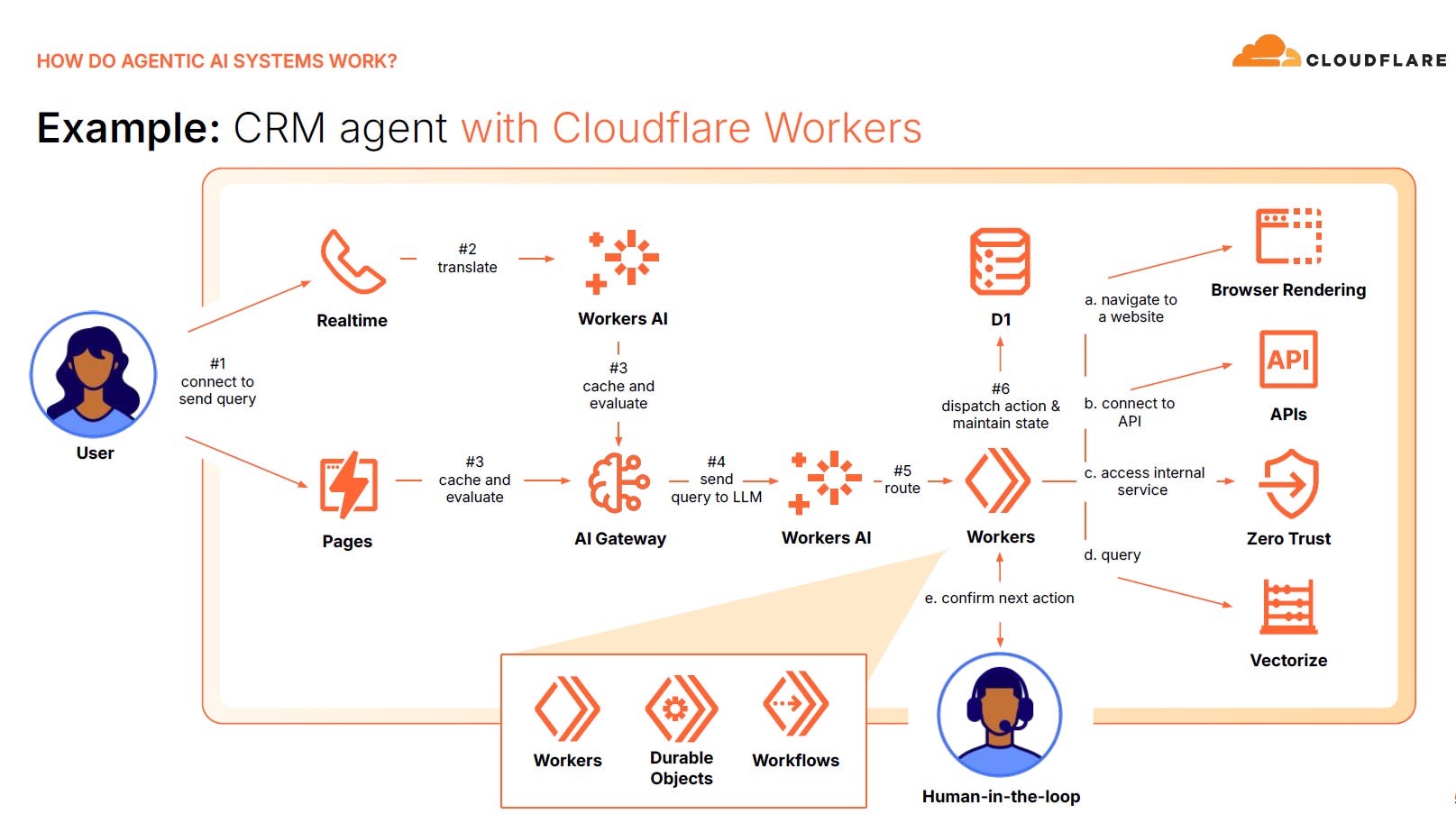
We’ve seen early versions of this inside portfolio companies — one founder built a lightweight agent that automatically logs post-demo notes into HubSpot. It saved reps 5+ hours a week and surfaced missed follow-ups they didn’t even realize were slipping through.
Where the Data Comes From
Frontier models like GPT-4 or Claude 3.5 are generalists. They’re trained on massive public datasets — think the entire indexed internet.
But to make a model useful inside your company, it needs domain-specific knowledge in two areas:
Workflow data — how your team actually sells, follows up, and reports.
Customer data — the proprietary context inside your CRM, emails, and notes.
Training a model from scratch is prohibitively expensive, so the practical path is to adapt existing models using three common techniques.
1. Retrieval-Augmented Generation (RAG)
RAG gives your model access to private data — docs, FAQs, CRM records — via a retrieval layer. When a query comes in, the system fetches relevant snippets and injects them into the prompt.
Think of it as giving your LLM an open-book test.
2. Fine-Tuning
Fine-tuning uses labeled examples from your domain (e.g., great email threads or sales summaries) to train the model to mirror your tone and reasoning style.
3. Tool Use & Function Calling
The most powerful agents act, not just answer.
Tool use lets an LLM call external systems — CRMs, ERPs, HR databases — to execute real-world actions. That’s how a CRM agent can actually send emails, update records, and sync tasks rather than just suggest them.
How Founders Can Get Started
If you’re a founder, you don’t need a research lab to build this. Start simple:
Step 1: Pick a narrow, high-leverage use case (e.g., “automate weekly lead follow-ups”).
Step 2: Use an off-the-shelf LLM and connect it to your CRM via APIs.
Step 3: Add RAG to ground the model in your company’s data.
Step 4: Layer in human-in-the-loop review so you can trust and improve the system.
Tools like Zapier, LangChain, or Dust make it easy to prototype this without a full engineering team. Start with a single API connection and measure the time saved — that data will justify expanding into more workflows. Once you prove value in one workflow, expand from there. Each agent you build compounds efficiency across the org.
The Bottom Line
CRM agents aren’t futuristic — they’re the next logical evolution of software automation. Founders who start building these systems today won’t just save time — they’ll redefine how their teams operate.
Every company that depends on customer relationships will eventually use one.
The earlier you start experimenting, the faster you’ll compound the benefits: cleaner data, faster execution, and a sales team focused on strategy, not spreadsheets.
Building one isn’t just about AI — it’s about leverage. And if companies like Cloudflare are already running more efficiently because of it, the question is how long others can afford to wait.